Twenty20 (T20) is cricket's shortest international format. Each team faces just 20 overs — 120 legal deliveries — so there is no time to settle in slowly. Every over has a purpose, and understanding the structure of a T20 innings makes the game far more rewarding to watch.
The Basics of a T20 Match
- Each team bats once, for a maximum of 20 overs.
- Each bowler can bowl a maximum of 4 overs, so a team needs at least five bowlers.
- The team with more runs at the end of both innings wins.
- A full match typically takes around three to three and a half hours.
If you are new to the game, start with our complete guide to cricket rules for beginners.
Phase 1: The Powerplay (Overs 1–6)
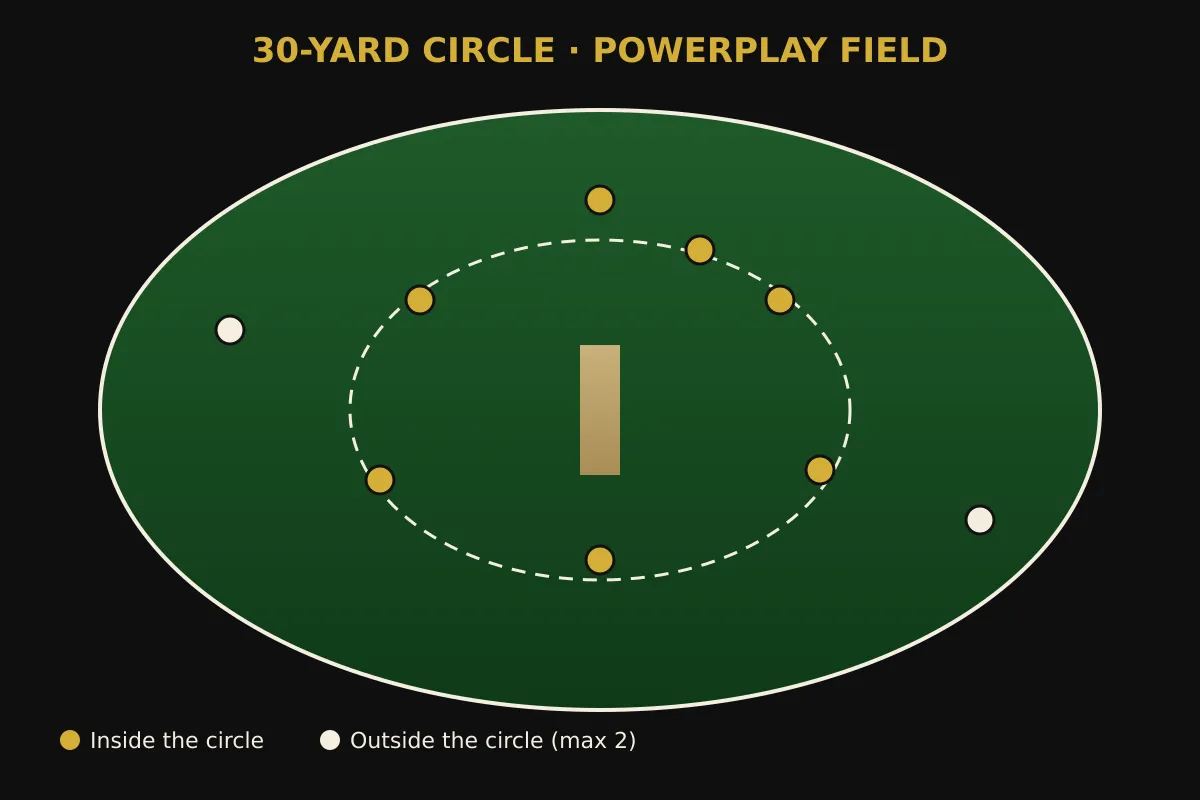
The first six overs of each innings are the powerplay. During this phase, only 2 fielders are allowed outside the 30-yard circle. With seven fielders inside the circle, there are gaps in the outfield, so batters attack.
What teams try to do
- Batting side: score quickly while the field is up, without losing too many wickets.
- Bowling side: take early wickets with swing and pace, and stop the flow of boundaries.
A strong powerplay gives the batting side a platform; early wickets can put them under pressure for the rest of the innings.
Phase 2: The Middle Overs (Overs 7–15)
After the powerplay, up to 5 fielders may stand outside the circle. Boundaries become harder to find, so batters look to rotate the strike with ones and twos and target specific bowlers.
This is often when spin bowlers do their best work. Captains use them to slow the scoring and tempt batters into risky shots. Losing wickets in this phase can derail an innings, while a steady partnership sets up a big finish.
Phase 3: The Death Overs (Overs 16–20)
The final overs are called the death overs. Batters take risks to score as many runs as possible, and bowling becomes a test of nerve and accuracy.
Death bowlers rely on skills such as:
- Yorkers — full deliveries aimed at the batter's feet
- Slower balls — changes of pace that disrupt the batter's timing
- Wide yorkers — full deliveries outside off stump to a defensive field
The difference between a good and a great T20 team is often decided in these 30 balls.
Fielding Restrictions and Over-Rate Penalties
International T20 cricket includes an in-match over-rate penalty. If the fielding team is behind the required over rate, it must bring one more fielder inside the 30-yard circle for the remaining overs. Slow bowling is therefore punished immediately, not just with a fine after the match.
Extras Are Expensive in T20
In a 120-ball innings, extras hurt. A no-ball gives away a run, an extra delivery and a free hit, from which the batter cannot be out in most ways. Wides also cost a run and an extra ball. Disciplined bowling is essential.
What Happens in a Tie?
If both teams finish on the same score, the match is usually decided by a Super Over: each team faces one over with two wickets available, and the team that scores more runs wins. Tournament rules explain what happens if the Super Over is also tied.
Rain and Reduced Matches
When weather shortens a match, overs are reduced and targets are recalculated using the DLS (Duckworth–Lewis–Stern) method. The length of the powerplay is also reduced in proportion to the shortened innings.
Tournament-Specific Rules
Franchise leagues sometimes add their own playing conditions. For example, some leagues allow substitutes known as impact players or use strategic time-outs. These rules belong to the specific tournament and are not part of standard international T20 cricket, so always check the playing conditions of the competition you are following.
How Teams Plan a T20 Innings
- Batting first: aim for a strong powerplay, keep wickets in hand through the middle overs, then accelerate hard at the death.
- Chasing: track the required run rate and avoid letting it climb too high. Wickets in hand give a chasing team the freedom to attack late.
- Bowling: match bowlers to phases — swing early, spin in the middle, specialists at the death.
Conclusion
A T20 innings has a clear shape: the powerplay, the middle overs and the death overs. Each phase brings different fielding rules, tactics and pressures. Once you recognise them, you can read a T20 game like an expert — understanding not just what happened, but why.
Compare T20 with the longer formats in Understanding the Different Formats of Cricket: Test, ODI and T20, or explore our Cricket Guides.